ChatGPT vs Claude: Which One Should You Choose to Build an App or Launch a Brand?
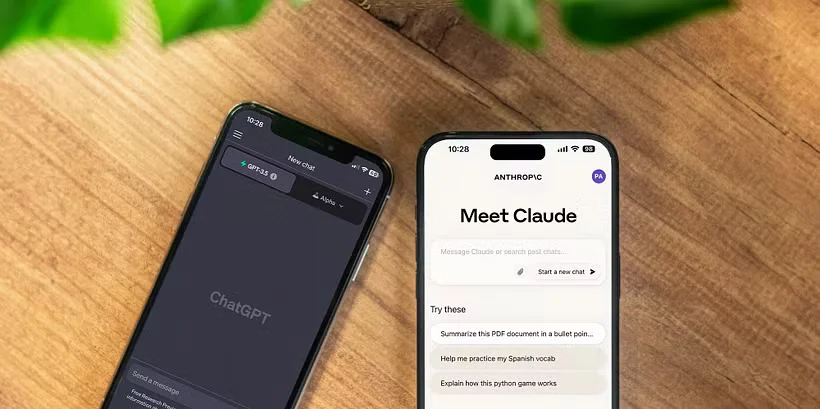
In 2026, it is no longer about “which is smarter,” but how well each tool adapts to the way you work. ChatGPT and Claude are two of the strongest options on the market, but they were designed with different philosophies: one tends to be a versatile all-purpose tool, while the other is more focused on reading and structuring long-form work.

By Rodrigo García
27 February, 2026
The right question is not “which one is better,” but:
Which one accelerates your path from idea → clarity → execution?
1. DNA Difference: The Approach of Each One
Claude: safety and structure as a principle
Anthropic trains Claude with a strong focus on safety and behavior. It publishes and updates its “constitution,” a document that guides how the model should behave, and recently announced a new version in January 2026.
What does that mean in practice?
▪️ It tends to be more careful.
▪️ It responds in a more organized way.
▪️ It is very good at working with long texts, reports, guidelines, and analysis.
ChatGPT: versatility and execution (with tools)
OpenAI is pushing ChatGPT toward “doing things”: reasoning, programming, vision, and more agentic workflows focused on producing deliverables. OpenAI presented GPT-5.2 as its most advanced model for professional work, highlighting reasoning, long context, programming, and vision.
What does that mean in practice?
▪️ It is more flexible for ideation and building.
▪️ It is usually better for prototyping concepts, names, messages, flows, and product structure.
▪️ When your goal is to “get something out into the world,” that speed matters.

2. If You Are Building an App: Which One Should You Choose and Why?
Building an app is not just code. It is:
clear problem → clear user → clear flow → clear MVP → iteration
Along that path:
ChatGPT tends to perform better for “building from scratch”
It can help with:
▪️ Defining features by priority (MVP vs “nice to have”)
▪️ User flows (what happens before and after)
▪️ Microcopy (text inside the app)
▪️ Screen structure
▪️ Business logic and edge cases (“what happens if…?”)
It can also help teams that code with:
▪️ Architecture explanations
▪️ Debugging errors
▪️ Translating ideas into specifications
Claude tends to perform better when a “world” already exists
That means when you already have long documents and want to organize them:
▪️ Long PRDs
▪️ Policies, terms, and guidelines
▪️ Comparative analysis
▪️ Large technical documentation
Anthropic is also pushing Claude toward a “productivity center” role by integrating apps such as Slack, Figma, Canva, and Asana through MCP. That can be powerful for teams.
Conclusion for apps:
▪️ Idea to MVP (fast): ChatGPT
▪️ Team + documents + control and organization: Claude (especially when connected to your operations)
3. If You Are Building a Brand: Which One Should You Choose and Why?
Building a brand is not making a logo. It means building:
▪️ Positioning
▪️ A credible promise
▪️ Personality
▪️ Tone
▪️ Messages that sell without sounding like an ad
ChatGPT tends to be stronger in applied creativity
For naming, concepts, narratives, campaigns, ads, scripts, and above all: iteration.
Your typical brand process can be accelerated through:
▪️ Creative territories (3–5 routes)
▪️ Naming by territory (20–50 options)
▪️ Filtering by intention (luxury / mass / premium / local / global)
▪️ Claim + key messages
▪️ Tone and style guide
▪️ Real examples: ads, scripts, posts, sales
- ChatGPT tends to be more “bold” when proposing different routes.
Claude is excellent at polishing and making the system impeccable
If you already have a long text—manifesto, verbal guide, pitch, or narrative—and want:
▪️ total consistency
▪️ cleaner structure
▪️ less repetition
▪️ better logic
- Claude can turn it into a polished “final document.”
Conclusion for branding:
▪️ Creative exploration + campaign + messaging: ChatGPT
▪️ Polished final document + consistency: Claude
4. Memory and Continuity: Who “Knows You” Better?
Both platforms are moving toward remembering context, but Claude has emphasized that its memory is optional and controlled, especially in work environments.
- For a team, that is key: if AI “remembers,” you want governance and control.
5. The Real Decision: What Are You Optimizing?
Ask yourself:
▪️ If your priority is speed to market
ChatGPT tends to win: it is more versatile for turning ideas into deliverables.
▪️ If your priority is consistency and organization in complex projects
Claude tends to win: it is a better “editor and organizer” when the project is already large.
6. The Smartest Move: Use Both With a Simple Workflow
If you want a system that truly moves you forward:
Phase 1 (creation): ChatGPT
▪️ idea → proposal → MVP → messaging → first campaigns
Phase 2 (consolidation): Claude
▪️ documentation → guidelines → manuals → consistency control
This is not “paying twice for no reason”; it avoids the typical mistake of wanting order before you have something alive.
7. Ready-to-Use Prompts (Without Making It Complicated)
For an app (ChatGPT)
▪️ “Help me define the MVP for this app: [idea]. Give me the ideal user, problem, value proposition, and 10 features ordered by priority.”
▪️ “Give me the complete user flow from registration to purchase, with screens and key text for each screen.”
▪️ “Give me a list of product edge cases and risks: payments, cancellations, support, fraud.”
For a brand (ChatGPT → Claude)
▪️ ChatGPT: “Give me 5 brand territories for [category] in Mexico, with personality, promise, tone, and an ad example.”
▪️ Claude: “Rewrite this manifesto so it sounds coherent, elegant, and rhythmic, without repetition. Keep the same message.”
If you are going to build an app or a brand from scratch, you normally need an AI that pushes you to produce and test in the real world. At that point, ChatGPT tends to be the engine. And when your project has grown and you want consistency, Claude becomes the editor and the system.
Are you ready to work with aliens?